Showing posts with label Emmerson Mnangagwa. Show all posts

Tuesday, 20 February 2018

“Zimbabwe After The Robert Mugabe Era”

“If snakes didn’t bite, they would be used to tie firewood” - Cameroonian Proverb.

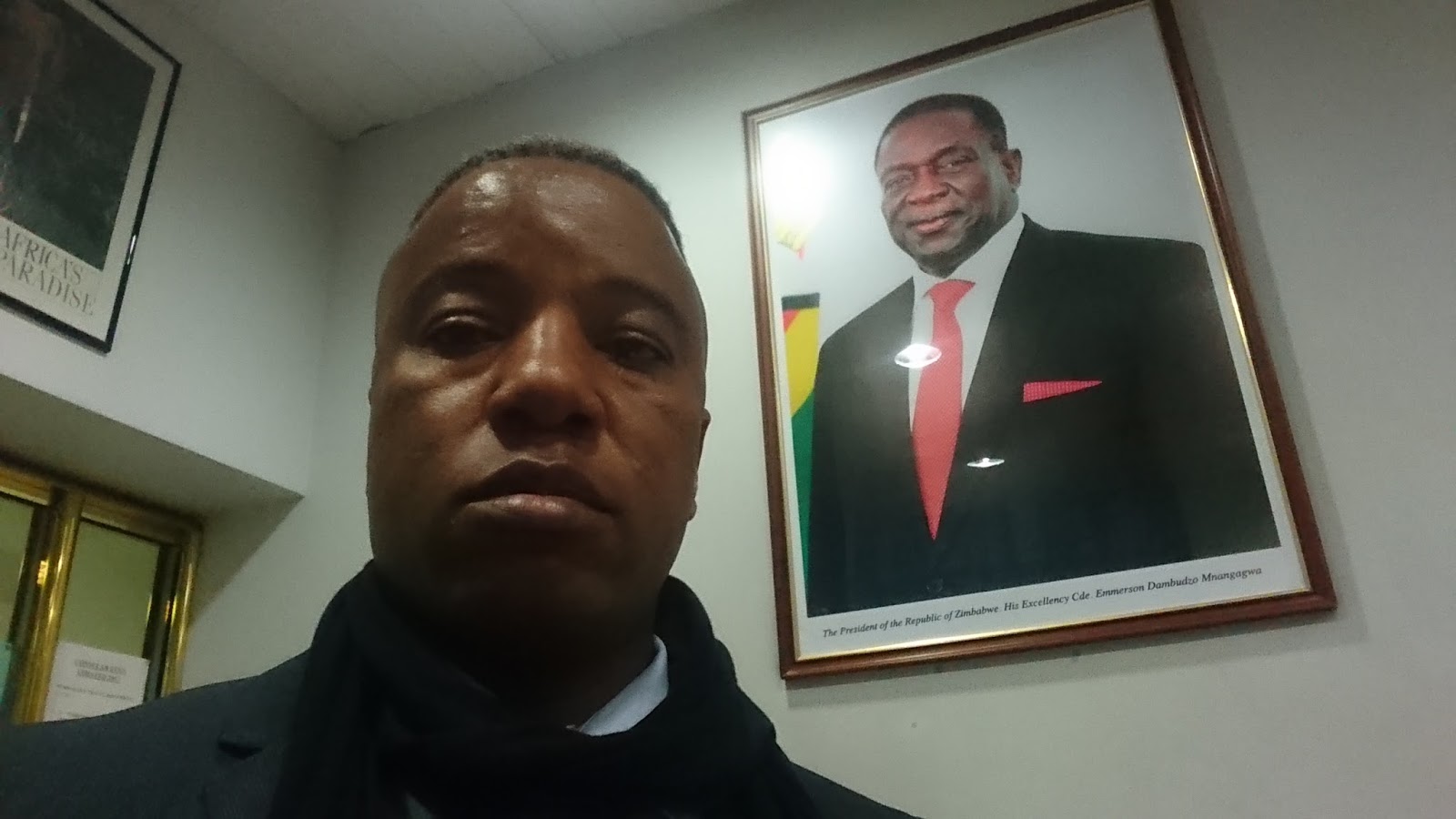
President Emmerson Mnangagwa. The President of the Republic of Zimbabwe.
by Kudakwashe Kanhutu

Against my better judgement, I attended the lecture of the above title at the School of Oriental and African Studies on 19th February 2018. I was in the area anyway, doing other things, so thankfully, I didn’t go out of my way too much. I am afraid this was an opinionated discussion not worthy of academia. I will not, like Plutarch before me (The Malice of Herotodus), go into a point by point refutation of all the false premises that were raised in this lecture. Instead, I will only say something about the tone of the whole event. The tone, besides being non-academic, was pessimistic, but what pessimists do not realise is this: they actually wish for the things they propagate. To the extent that, if they had the means, they would midwife the scenarios they envision.

But, fortunately, as the Shona saying goes: “Kuhukura kwembwa hakutadzise Nzou kufamba” (“the barking of dogs does not prevent elephants from travelling along their paths”), the practitioner does not have the luxury of the armchair-know-it-all, he must act whatever the odds. Even more fortunately, if you were to read what these so called experts who led the discussions yesterday wrote, prior to the current Zimbabwean government taking over, you will find that they have always been off the mark. Theory has its limits. It's at that limit that the genius practitioner takes off and thrives.

Arriving at the School of Oriental and African Studies.
The President of the Republic of Zimbabwe.

Sunday, 26 November 2017

Fate Has Given Zimbabwe's New President The Easiest Of Tasks!

Mr President! Comrade Emmerson Mnangagwa, Zimbabwe's New President.
by Kudakwashe Kanhutu

For me, my President's task is very simple, to do only those things that are defensible as being in Zimbabwe's (objective) Nationalist Interest. Zimbabwe's National Interest, too, cannot be divorced from Zimbabwe's foundational story - the Chimurenga War Story.

For the outsider who wishes to engage with Zimbabwe, your task is simple too - engage in a way that is defensible as advancing Zimbabwe's (objective) National Interest.

I cannot think of anything simpler.

Thursday, 28 July 2016

The Tribal Aspect In Zimbabwe’s Succession Politics.

“Nulla fides regni sociis omnisque potestas; impatiens consortis erit” - Marcus Annaeus Lucanus. [“There is no friendship between those associated in power; he who rules will always be impatient of an associate”].

The Vice President of the Republic of Zimbabwe, Comrade Emmerson Dambudzo Mnangagwa.
Realities in the Post-Colonial African State have scant regard for the anthropologist's comfort. Just when my project of mapping all the tribes in Zimbabwe and assigning them their true interests was nearing completion, new tribes have just emerged there. In staying true to the anthropological spirit, I cannot, as yet, give them definitive names or descriptions since much further study is required. I cannot, as yet, enumerate them though I have observed two and can infer from these that other new tribes have also come into existence. I cannot, as yet either, say whether the two new tribes I have observed are mutually exclusive or not. 

But to understand alright what I mean by new tribes, we have to revisit what one respected intellectual observed about "tribes" in the 21st Century in, of all places, Washington DC. He observed that politics in the United States's seat of power followed the same dynamics followed by tribal politics in the most primitive stages of human history. Whatever new forms of affiliation we now have - guilds, ideology, similar pastimes - have replaced tribes as the new "tribes" in modernity. Wall Street is a tribe. 

The two new tribes that have emerged in Zimbabwe's succession politics thus are what we can provisionally call the "Corrupt Tribe" and the "Security Tribe." The "Corrupt Tribe" prefers the current rot to persist as it has guaranteed them a seat at the table that they couldn't possibly reach through merit. The "Security Tribe," on the other hand, want gradual change that takes into account national values and the realities of the globalised world. I surmise that there must be a "Human Rights Tribe," "Business Tribe," "Law Tribe" etc but I suspect, for now, that these other tribes can find their full expression in one of the two main tribes I have sketched out above. 
Saturday, 28 November 2015

The Land Question Is Zimbabwe's ONLY National Question


The condition of the black farm worker in Zimbabwe between 1893 - 2000
On this issue I cannot prevaricate as all academics do: a country's national question is that question which when resolved satisfactorily, will cause all other questions to resolve themselves. If you resolve the land question - once and for all - everything else will fall into place. Of course, when a crisis has gone on long enough, it's easy to forget the initial condition and thus mistake a concomitant question for the actual national question i.e. mistaking the shadow for the substance. It is also easy to - with hindsight - think there was a better way of doing things and, by so doing, revise history. 

Speaking at Oxford University, the Commander in Chief of the Economic Freedom Fighters of South Africa - Julius Malema - accused President Robert Mugabe of being an opportunist who only used the land issue as a way to hold on to power when he was falling out of favour in Zimbabwe. Julius Malema then went on to say that land reform could have been done through changing the constitution instead of the extra-legal and violent way it was conducted in Zimbabwe. In this postulation he revises history as, indeed, the legal means were tried (to no avail) and he also fails to realise that land law is not really a sovereign issue - by which I mean, outside forces can frustrate any attempts to enshrine land reform in national constitutions:

Video: Whose Land Is It Anyway


The condition of the black farm owner 2000 - present

Friday, 20 November 2015

Africa Imported The Wrong State

Importing the wrong state.

The argument of "The Imported State" restated, in the fewest possible words, is that Africa imported the wrong State. The operational concept being that every society has an organic way of organising its political life that best fits it (given its values) - there is no one size fits all.

This idea, when diagrammatically represented would be this: the foundation of the State in Africa is circular (round), yet the superstructure it has been sent is in the shape of a square. Thus the imported state will never take root in Africa.

Friday, 28 August 2015

President Robert Mugabe's 2015 State of the Nation Address

President Robert Gabriel Mugabe. The Commander-in-Chief of the Zimbabwe Defence Forces.
The story is told of the (improbable) encounter between five blind men and an elephant (possibly sedated). Whatever part of the elephant each person came across became his view of what an elephant was really like. The one who held the trunk thought it was a like a thick rubbery hose, the one who held the leg thought it was like a tree trunk or pillar, while the one who held the tail thought it was like a rope. 

The story does not explicitly say this but I assume they all agreed that it was an animal. I hope they did. It is the same with our recently delivered State of the Nation Address. We must all agree that the state of affairs in Zimbabwe are not ideal at all. But, beyond this agreement, we can become like the 5 blind men and highlight different things in the address owing to our 'contact,' prejudices, world views, and levels of understanding. Thus, I beg to differ with anyone who has ever uttered, written or thought that the State of the Nation address was a pointless exercise.

What President Mugabe mentioned almost in passing in this speech, is for me the fundamental issue. He mentioned the fact that the security services have ensured that there is peace and security in the most trying of circumstances. Everything must build on this foundation of security. A passage by John Stuart Mill is instructive as to how impossible it is to achieve anything where there is no security. I am well aware that security has since been broadened to include economic, climatic, personal and political security in the 21st Century, but still, all these aspects of Human Security depend on there being peace in a given territory.