Showing posts with label Africa. Show all posts

Monday, 18 June 2018

The Nelson Mandela I Didn't Know

“A society grows great when old men plant trees whose shade they know they shall never sit in” – Greek Proverb.

Larger than life.


by Kudakwashe Kanhutu 

I am Zimbabwean, so inevitably, my knowledge of Nelson Mandela comes to me filtered by comparing him to Robert Mugabe, and that comparison, inevitably again, was coloured by what Robert Mugabe made us believe Nelson Mandela was: someone who had sold out the South African struggle for his personal freedom and veneration in the West. At least, that’s what I believed up until November 14, when those in the know in Zimbabwe, finally decided to put an end to Mugabe’s excesses. I am not here to talk about their motivations, what interests me about that episode is that it midwifed - if you like – my Road to Damascus moment. I finally saw the light and so managed to compare Robert Mugabe and Nelson Mandela on what really mattered: Leadership. 

Forget that I had done a full Leadership Module at undergraduate level that specifically examined Mandela, Gandhi, and Pope John Paul’s leadership styles. Mugabe’s words had still managed to colour my view and I always thought Mandela had failed as a leader. After my Damascene moment however, Barack Obama’s words at the African Union in 2015 now explicate affairs for me. Obama said to the gathered African leaders; “if you are the only person who can lead your country, then you have failed as a leader.” 

Indeed, that it took the military and street protests to force Robert Mugabe to pave way for a successor, with the dangers of an all-consuming civil war had any mistake crept into the military’s planning, is proof enough of failed leadership. These events in Zimbabwe in November made me re-think Mandela. Nelson Mandela suffered more than Robert Mugabe while fighting for freedom: but he did not use this an excuse to hold on to power for power’s sake. More popular than Robert Mugabe though he was, Mandela did not try to install himself as life President. This lack of a sense of entitlement, this selflessness, is what I am now drawn to. I now identify Mandela with his selflessness than with any of the aspersions Robert Mugabe cast on him all along. There are lessons from Mandela to anyone who is ever entrusted with leading their nation. If enough old men start planting trees whose shade they know they shall never sit in, our African polities will have turned the corner. Mandela showed this by example.

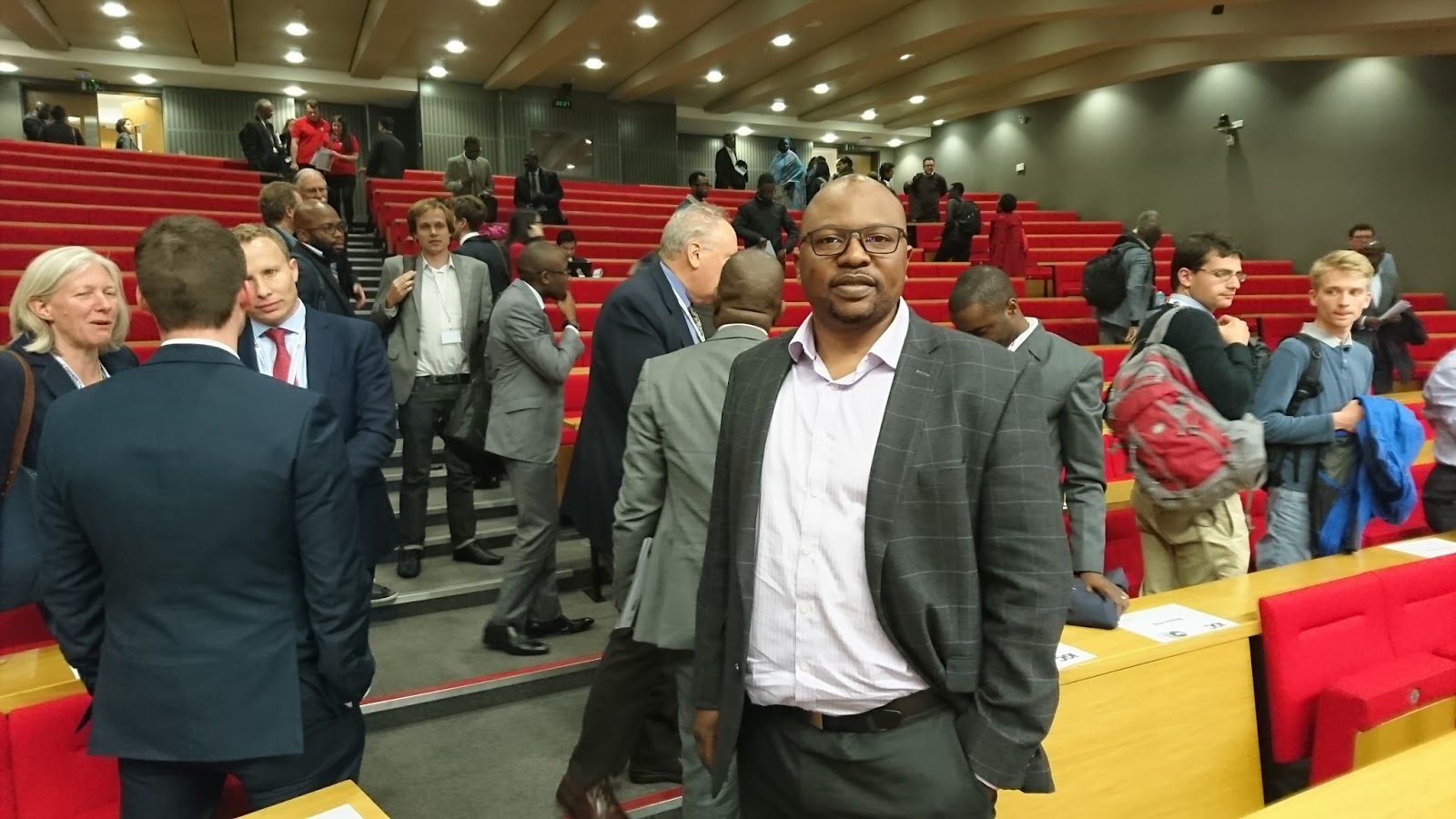
Luyanda and I at a Nelson Mandela Event in London.

Tuesday, 20 February 2018

“Zimbabwe After The Robert Mugabe Era”

“If snakes didn’t bite, they would be used to tie firewood” - Cameroonian Proverb.

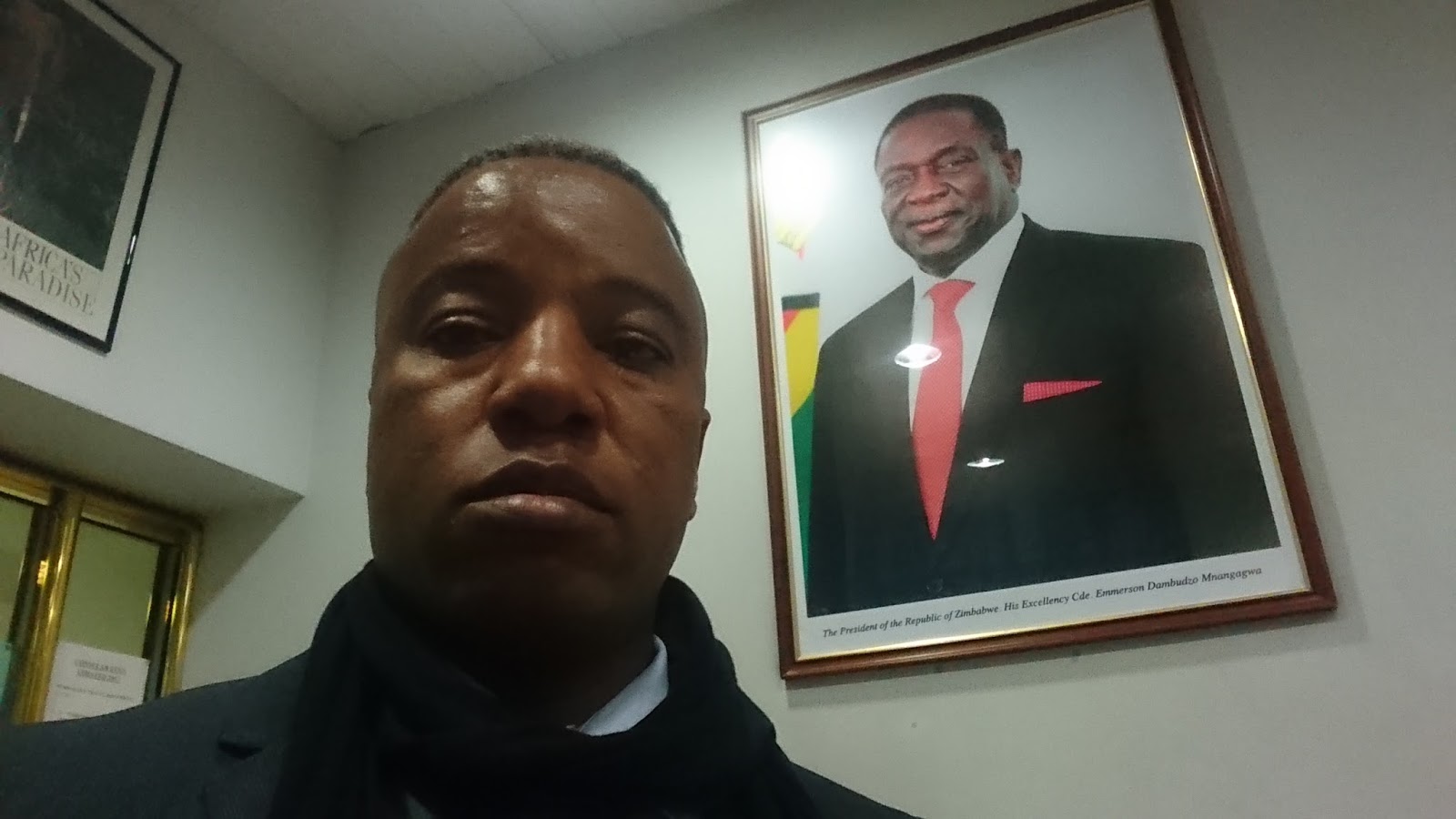
President Emmerson Mnangagwa. The President of the Republic of Zimbabwe.
by Kudakwashe Kanhutu

Against my better judgement, I attended the lecture of the above title at the School of Oriental and African Studies on 19th February 2018. I was in the area anyway, doing other things, so thankfully, I didn’t go out of my way too much. I am afraid this was an opinionated discussion not worthy of academia. I will not, like Plutarch before me (The Malice of Herotodus), go into a point by point refutation of all the false premises that were raised in this lecture. Instead, I will only say something about the tone of the whole event. The tone, besides being non-academic, was pessimistic, but what pessimists do not realise is this: they actually wish for the things they propagate. To the extent that, if they had the means, they would midwife the scenarios they envision.

But, fortunately, as the Shona saying goes: “Kuhukura kwembwa hakutadzise Nzou kufamba” (“the barking of dogs does not prevent elephants from travelling along their paths”), the practitioner does not have the luxury of the armchair-know-it-all, he must act whatever the odds. Even more fortunately, if you were to read what these so called experts who led the discussions yesterday wrote, prior to the current Zimbabwean government taking over, you will find that they have always been off the mark. Theory has its limits. It's at that limit that the genius practitioner takes off and thrives.

Arriving at the School of Oriental and African Studies.
The President of the Republic of Zimbabwe.

Sunday, 12 June 2016

Industrial Development – China and Africa IGC Public Discussion at the LSE: What Was Said

"You can learn from anyone, even your enemy" - Ovid, Roman Poet. 

The Comrades at LSE. Industrial Development - Africa and China. LSE June 2016.


If a conference, lecture, or discussion has Africa in the title, my Comrades and I will spare the time (and no expense) to attend. It being a long accepted principle among ourselves that you can never have too much information/knowledge on a subject you care about. We have no other true home but on the African continent and, wherever we may find ourselves to be at present, is in but a transient home. 


Whenever I think about the duty that the African, wherever he or she may be, owes to the continent, my mind always goes back to my reading of Joseph Conrad’s The Heart of Darkness (HoD). The dedication to exploiting Africa that Mr Kurtz and his cohorts in the “Society for the Suppression of Savage Customs” had, in HoD, is the same dedication the African – wherever he/she may be – must have in contributing to Africa’s becoming primus inter pares of the continents.

Of course, I do not say this in the spirit of Pan-Africanism, because I think Pan-Africanism is a very unwieldy and wishy washy concept. The units of analysis that interest me are the African countries (separately) and, the African – wherever he or she may be – must look to contribute to his or her country’s developmental success, which will, in turn, automatically translate to Africa’s developmental success. I do not have to say anything more on this idea as even a child can understand it in the form I have presented it here. 

The Economist who discovered/articulated the concept of scarcity should be awarded a Nobel Prize for Economics every year: such a simple concept, yet it explains a lot. There are so many conferences and discussions with Africa in the title that there is just not enough time to attend them although the will is there. That is scarcity 101 for you right there! It is for this reason that my Comrades and I have had to do something that is the complete antithesis of our constitution: discriminate. It’s un-African to discriminate but we have been forced to choose to go to only the conferences and discussions at the highest ranked institutions and where the highest ranked public speakers are in attendance. It’s a pandering to elitism that I am usually very much against, but you can’t win them all.

With these considerations in mind, we attended the International Growth Centre’s June 2016 public lecture series at the London School of Economics and Political Science. The one we chose was as above stated: Industrial Development – China and Africa. The question to answer in these discussions has always been; can Africa copy the China model and develop in leaps and bounds as China has done in the past 15 years? Forget not that, as recent as 1999, Chinese people were dying in shipping containers while escaping poverty in China as Africans are doing in the Mediterranean Sea at the moment. It is this question of the China model we wanted to get some clues to. Make no mistake, there are no definitive answers in these discussions about complex affairs such as these. You only get some nuggets of information, some clues, and some hypotheses. The best you can hope for is that these nuggets will come in handy at some appropriate time. 

I have rambled on, let me get to the point of this blog entry, which is: what was said at the Industrial Development – China and Africa Public Discussion. A lot was said and some of the things completely escaped me because you can only understand the things that can be processed by your frame of reference. I went wanting to know why Zimbabwe and Mozambique haven’t “strong armed” China into developing the Port at Beira and the road and rail link to Harare into an international standard facility. Beira is very near to Harare, just 284 miles,compared to Durban’s 830 miles and Walvis Bay’s 1127 miles. I got my answer to that question, but it will need a whole separate blog entry to discuss that answer. 

The one thing that made me really sit up and listen was when one Economist touted the possibility that Africa could now become China’s sweat shop as China was the world’s sweat shop in its development. It is now possible, and necessary, for China to outsource its manufacturing to Africa as its present affluence means that it is no longer cost effective to manufacture goods in China. The same economist went on to say that Ethiopia could have 318 000 jobs created as a result of this outsourcing, these are mouth-watering numbers compared to the just 114 000 people Ethiopia currently employs in its manufacturing sector. The trick for the African governments is to be aware of this possibility, then create conditions that allow for the manufactured goods to be transported across borders without much delay. The benefit to the African governments is that they will have an employed population (tax base) and the knowledge and skills transfer that comes with such a venture. In time, and with affluence, these African countries will also look to make places like Europe their sweat shops once it is no longer cost effective to manufacture goods in the African countries. Of course, a China expert also talked about the problems of the China model, but that is a discussion for a whole separate blog entry and a different day.


Industrial Development - Africa and China. LSE June 2016.

Industrial Development - Africa and China. LSE June 2016.


Industrial Development - Africa and China. LSE June 2016.

Industrial Development - Africa and China. LSE June 2016.

Industrial Development - Africa and China. LSE June 2016.


Industrial Development - Africa and China. LSE June 2016.


Wednesday, 1 June 2016

Zvakaipei Kutoodza Tsika Dzevamwe/Is It Necessarily Bad To Copy Foreign Customs?


“Kana tsika nemagariro evanhu vakasiyana siyana dzikaunganidzwa panzvimbo imwe chete, mumwe nemumwe anotora tsika nemagariro enyika yake, sezvo vanhu vese vachifunga kuti dzavo tsika dzakanaka kukunda dzevamwe vese” – VaHerodotus, Nhoroondo Dzepasi Chigare.

Uyo mubvunzo wandabvunza pamusoro apo uyo wakauya mupfungwa dzangu mwedzi wapfuura, sezvo ndakwanisa kufunga nezvawo kwemwedzi wese, mhinduro ndave nayo. Vazhinji vanoteedzera zvandinonyora paFacebook pangu vanoziva kuti ndiri pakati pekunyora bhuku rangu pamusoro petsika nemagariro evanhu vemuZimbabwe. Mubhuku iri ndirikuda kunyatsocherechedza kuti ndione kuti tichiri kuchengetedza tsika dzedu here, uye takasiyana papi mumagariro edu nevanhu vedzimwe nyika. Bhuku rangu parinopera, richakwanisa kuudza avo vachateera kumashure kwedu kuti vanhu veZimbabwe vanobvepi, vanoendepi, uyezve ndevapi vanokodzera kunzi vana veZimbabwe. Pamusoro peizvozvi, richadzidzisa vanhu kuti ndedzipi tsika dzakakodzera kuchengetedzwa uye ndedzipi dzakakodzera kuraswa sezvo dzinenge dzisisafambirane nenguva.

Nekuti handisi kuda kurembesa munamato sadza richiripora pano apa, ndichangoti ga ga pakudaira mubvunzo wandabvunza pamusoro apo uyo. Bhuku rangu rinoshoropodza mauyiro akaita vachena munyika yeZimbabwe, asi parinosiyana nevatongi vedzimwe nyika vanoshoropodza kuuya kwevachena zuva nezuva asi ivo vachiteedzera tsika dzevachena, pamwe chete ipapo vachinyara tsika dzedu dzechitema ndepekuti, rinoti; hazvisi zvese zvakaunzwa nevachena zvakashata. Chakashata chete mauyiro avo. Aya haasi mashoko angu aya, mashoko avaCesaire pavainyora Nhoroondo Yavo Yemauyiro eVachena kuAfrica. VaCesaire vanoti ivo vanhu vega vega vanoda kusangana nevamwe kuti vadzidzisane zvinhu zvakasiyana siyana zvinenge zviri zvitsva kwavari. Ivo vachena vacho vakakwanisa kubudirira nekuti vaifamba munyika dziripedyo navo vachiteedzera zvakanaka zvavainge vasina munyika dzavo. Dai vakauya pahushamwari kuAfrica, ropa rakawanda ringadai risina kumbo deuka.

Kuti ndinyatsopindura mubvunzo wangu regai ndikupei mufananidzo uyu: handizive kana makaverenga here bhuku rinonzi Mapatya. Mapatya ibhuku rinoti pasi chigare kwaiti kukazvarwa mapatya, vanhu vaiti zvinoshura munhu kuzvarwa vana vaviri, saka mwana mumwe chete aitourayiwa kosara mumwe chete chete. Regai ndibva ndangokuudzai kuti iyi ingori ngano, hazvireve kuti ndozvaiitika zvechokwadi, asi chidzidzo chatinogona kuwana ipapo chakakosha zvakadaro. Ngatitii vamwe vanhu vedunhu rakavakidzana neredu vobva vangokwanisawo kuziva kuti chii chaicho chinokonzera kuti mapatya azvarwe, vosiya tsika iya yekuuraya mumwe chete wemapatya – poshaya shura rinoitika kwavari - vakatishanyira vakatitsanangurira magariro avavakuita kubva pavakaziva izvi, isu tinogona kuteedzera tsika yavo yavave kuita zvisinga kanganise kana chinhu chimwe chete pamagariro edu. Zvishoma izvozvo zvandataura izvi zvinofanirwa kutiudza kuti hazvina kuipa kuteedzeera tsika nemagariro evamwe akanaka kana pasina zvakaipa zvinobva zvawira vanhu vemunyika medu patinoteedzeera zvekunze izvi. Zvinhu zvatinenge tateedzera kubva kunze zvinofanirwa kuti zvingoitwa kuti zvive zvinoenderana nezvimwe zvakanaka zvinenge zviri mutsika nemagariro edu nekare.

Is It Necessarily Bad To Copy Foreign Customs?

“For if one should propose to all men a choice, bidding them select the best customs from all the customs that there are, each race of men, after examining them all, would select those of his own people; thus all think that their own customs are by far the best”- Herodotus, The Histories.

The above question occurred to me about a month ago, as I have had a full month to think it over, I also now have an answer for that question. As many who have seen my Facebook posts are well aware, I am in the middle of writing my own book. My own book interrogates what it means to be Zimbabwean, interrogates our national identity and how we are distinctly different from people from other countries. On completion, my book will inform posterity on our origins, our future and on who has the right to claim to be Zimbabwean. Moreover, my book will locate Zimbabwe’s place in the international system in such a manner that Zimbabweans will know where exactly to draw their red lines against encroachment by the forces of globalisation (in all spheres).

For brevity’s sake I will just answer the question I asked above without taking the circuitous route. Although, in essence, my book is a nationalist’s playbook, it differs from politicians’ rhetoric in that it is sober in its assessment of the impossibility of maintaining pure identities, customs and cultures. The mixing of cultures was inevitable, what was wrong about it was how the white cultures imposed themselves in Africa. These are not my own words but those of Cesaire when he wrote his A Discourse on Colonialism. In that discourse, Cesaire maintains that contact between civilisations is the oxygen that keeps civilisations alive, he only says that Colonialism was not the best way of making contact. He also points out that Europe's polities developed by learning from others who were in close proximity. The Renaissance and Enlightenment being typical examples. A different kind of contact between Europe and Africa would have spared so much bloodshed.


To answer my above posed question with imagery, let me give you this example; I don’t know if you read the Shona book, Twins. In this book, the birth of twins was thought of a something foreboding doom, and that doom could only be averted if one of the twins was killed soon after birth. I do not need to tell you that Twins is a work of fiction and that this did not necessarily happen in a particular epoch, still an important lesson can be drawn. Suppose a neighbouring people finds out, by trial and error, that no doom will descend on the people because both twins were allowed to live, and suppose these people visit us and tell us this, we can easily adopt their way of doing things without any cost to our polity. This is my whole point, that we can adopt other people’s customs as long as they do not ruin our people. What we will adopt from foreigners will then just be streamlined and adapted to go along with the great customs we already have.

I still have not settled on a book title.

Monday, 28 March 2016

The Origins Of Zimbabwe's Defeatist National Psyche

"Religion is regarded by the common people as true, by the wise as false, and by the rulers as useful" - Lucius Annaeus Seneca.


“God has done his will.” Have more defeatist words ever been uttered?

In Part I of this thread, I gently suggested that the Zimbabwean national psyche is largely defeatist, and I also promised to explain to you why this is the case. The case I was building against Zimbabweans was that they do not interrogate cause and effect as much as they should. I have been confounded lately by the propensity, of otherwise sane Zimbabweans, to believe the most ridiculous speculations by their so-called prophets. I remember returning home from one of my long absences to be told by my grandparents that their “prophet” had said that, because of his prayers, the floods that inundated Mozambique were prevented from reaching us. Now, my grandparents come from a different era. So, I just told them that it may also just have been because Harare is so far from Maputo and the Indian Ocean that the floods did not reach us. 

The other generations beside our grandparents, however, cannot get away lightly considering that the country spent money it didn’t have to make sure we all got an education. What is education but the ability to interrogate cause and effect better? To be sure, the lessons and thought patterns inculcated in us by our grandparents have an impact upon us. Don’t forget I am not happy that Zimbabweans held national prayers for rain when the science is clear how El Nino works. Forget not, also, that sane and well educated people are subscribing to the aforementioned so-called prophets and their “judgement nights” whose predictions never come true. Remember, esteemed reader, the silly promises of “miracle money” and “anointed oils” and the large crowds they draw among Zimbabweans. The mind boggles! 

But why are we like this? Could childhood socialisation be such an all-powerful force that can counteract any classroom education? Surely the refusal to interrogate cause and effect must have its roots in what we were made to believe is the way the world works when we were pre-school age. If I were to reduce what we internalised as children to just one statement, it will have to be: “Mwari vaita kuda kwavo/God has done his will.” This was the ubiquitous statement in every household in every part of the country. What undergirds this statement is a belief in predetermination. It does not matter what positive actions you do to change your situation, if God does not will it, it will not happen. Has a more defeatist idea ever been propagated to a whole nation? 

Now, there is a whole philosophical debate here about manifest destiny, freewill etc which I have no space to go into. Instead, it is my observation that this ubiquitous statement – God has done his will – has made the Zimbabwean psyche very pliable: anyone who invokes God can make the most ludicrous proposal and a Zimbabwean will entertain that idea. “God has done his will” is a good statement to console the grieving, but as a foundation for action it lends a whole nation susceptible to defeatism.

Saturday, 30 January 2016

Zimbabweans Do Not Like To Honour Their Heroes Properly

"Go and tell the Spartans, stranger passing by, That here, obedient to their laws, dead we lie" - Simonides of Ceos (556-468BC), Epitaph on the monument marking the Battle of Thermopylae (480 BC).

It is an anomaly is it not? (As I read more into Zimbabwe’s history) that Changamire Dombo defeated the Portuguese using superior military tactics way back when - and the Portuguese even acknowledged this rout in their historical documents - yet travel the length and breadth of Zimbabwe, you will not find a single statue commemorating Changamire Dombo’s military genius. Search high and low, and you will not find this victory honoured in any medium - drawings, films, re-enactments, nothing! 

Yet, here I am, in the picture above, in Thermopylae, at a monument erected in honour of King Leonidas of Sparta who lost a battle here to the invading Persians in 480 BC. There already has been 2 major films made in honour of King Leonidas and his 300 Spartans. When I arrived in Athens, while relaxing and trying to get my bearings, I was talking to a young medical student in the Gazi District. Not only did she know of, word for word, the Battle of Thermopylae, she also recited the stories of Thucydides, Herodotus and Homer. I, on the other hand, am only getting to know the stories of my country the hard way, and retro-retrospectively too.

"Three hundred Spartans and their allies held off the invaders for seven days, until, their weapons smashed and broken from the slaughter, they fought 'with bare hands and teeth' (as recorded by Herodotus) before being at last overwhelmed.

Thermopylae means Hot Gates, named so because there are hot springs at this place. On the day I visited, it was overcast and raining, the mist you see there comes from the hot springs that are still active to this day. There can be no mistaking the site of the battle.

Wednesday, 13 January 2016

Why I Ran In 2016?

“If you are planning for a year, sow rice; if you are planning for a decade, plant trees; if you are planning for a lifetime, educate people" - Chinese Proverb.


For all my study of Greek political thought, I couldn’t tell you who predates the other, Sophocles or Aristotle? I only mention this because the point I want to rely on in this blog entry, was made by both authors, yet I cannot decide who was reaffirming the other. Sophocles said call no man happy until he is dead, while Aristotle went even further and said; even if a man lives an excellent and happy life, we cannot call him happy either if his offspring fall into ruin after his death.

This tells me that it is not advisable for any mortal to claim to have the right formula for an excellent life. So, although what I am doing this 2016 is inspired by my own childhood experiences, I know it is only one of the possible pathways to excelling in life. I do not claim to be living the happiest possible life either or, even, to be in the vicinity of my goals in life. What I do claim, instead, is that I am satisficing, by which I mean I am heading in the general direction of those goals. 

What started me off in the general direction of my goals is that, growing up in rural Zimbabwe, my Grandfather had a thick volume Who’s Who among his very few books. Reading what other people had achieved must have sowed the idea in my mind to emulate their pathways. It is this start in life, I wish for every one of my rural countrymen. 

Now, the circuitous introduction I have put up above is only meant to support one idea and one idea only: access to books and knowledge must make for a happier life than living in ignorance. It is with this idea in mind that I have decided to make all my Marathons and Half Marathons in 2016 to be in aid of raising money to send books to rural areas in Zimbabwe. 

My Grandfather - John Kanhutu. Later, I will tell you about the social compact he had with President Mugabe and, my place in that compact.

Thursday, 24 December 2015

They Serve God Too, Those Who Act Rather Than Just Pray.

They serve God too, those who act rather than just pray.

That I do not reaffirm my Christian faith as often as I should is remiss, but, sufficiently excused by this passage recited by that Honourable and Ingenious Knight of antiquity; Don Quixote of La Mancha. Summed up, his argument is this; they serve God too, those who act rather than just pray.

"For, if the truth is to be told, the soldier who executes what his captain orders does no less than the captain himself who gives the order. My meaning, is, that churchmen in peace and quiet pray to Heaven for the welfare of the world, but we soldiers and knights carry into effect what they pray for, defending it with the might of our arms and the edge of our swords, not under shelter but in the open air, a target for the intolerable rays of the sun in summer and the piercing frosts of winter. 

Thus are we God's ministers on earth and the arms by which his justice is done there in. And as the business of war and all that relates and belongs to it cannot be conducted without exceeding great sweat, toil, and exertion, it follows that those who make it their profession have undoubtedly more labour than those who in tranquil peace and quiet are engaged in praying to God to help the weak" - Don Quixote: The Ingenious Gentleman of La Mancha.

They serve God too, those who act rather than just pray.

Friday, 20 November 2015

Africa Imported The Wrong State

Importing the wrong state.

The argument of "The Imported State" restated, in the fewest possible words, is that Africa imported the wrong State. The operational concept being that every society has an organic way of organising its political life that best fits it (given its values) - there is no one size fits all.

This idea, when diagrammatically represented would be this: the foundation of the State in Africa is circular (round), yet the superstructure it has been sent is in the shape of a square. Thus the imported state will never take root in Africa.

Tuesday, 20 October 2015

The Tyrannical Character (as desribed as long ago as the 5th Century by Plato).

The Republic
A Synopsis Of Plato’s The Republic

Plato's The Republic is widely acknowledged as the cornerstone of Western philosophy. Presented in the form of a dialogue between Socrates and three different interlocutors, it is an inquiry into the notion of a perfect community and the ideal individual within it. During the conversation other questions are raised: what is goodness; what is reality; what is knowledge? The Republic also addresses the purpose of education and the role of both women and men as 'guardians' of the people. With remarkable lucidity and deft use of allegory, Plato arrives at a depiction of a state bound by harmony and ruled by 'philosopher kings.' 

PART IX, BOOK VIII, IMPERFECT SOCIETIES. 

The Tyrannical Character 

Its essential similarity to the criminal 

... ... “There do indeed.”


“In this struggle don’t the people normally put forward a single popular leader, whom they nurse to greatness?”


“Yes, as a rule.”


“Then it should be clear,” I said, “that this leadership is the root from which tyranny invariably springs.”

“Perfectly clear.”

“Then how does the popular leader start to turn into a tyrant? Isn’t it, clearly, when he starts doing what we hear about in the story about the shrine of Zeus Lykaeus in Arcadia?”

“What is the story?”

“That the man who tastes a single piece of human flesh, mixed in with the rest of the sacrifice, is fated to become a wolf. Surely you’ve heard the tale?”

“Yes, I have.”

“The same happens with the popular leader. The mob will do anything he tells them, and the temptation to shed a brother’s blood is too strong. He brings the usual unjust charges against him, takes him to court and murders him, thus destroying a human life, and getting an unholy taste of the blood of his fellows. Exiles, executions, hints of cancellation of debts and redistribution of land follow, till their instigator is inevitably fatally bound either to be destroyed by his enemies, or to change from man to wolf.”

“That is an inevitable necessity.”

“It is he who leads the class war against the owners of property.”

“It is.”

“And if he’s exiled, and then returns in spite of his enemies, he returns a finished tyrant.”

“Obviously.” ... ...

... ... ... “Meanwhile there’s clearly no question of our champion ‘measuring his towering strength in the dust’; he overthrows all opposition and grasps the reins of state, and stands, no longer champion, but the complete tyrant.”

“That’s the inevitable conclusion,” he agreed.

“Then shall we describe the happy conditions of this man, and of the state in which a creature like him is bred?”

“Yes, please, let us.” 

“In his early days he has a smile and a kind word for everyone; he says he’s no tyrant, makes large promises, public and private, frees debtors, distributes land to the people and to his own followers, and puts on a generally mild and kindly air.”

“He has to.”

“But I think we shall find that when he has disposed of his foreign enemies by treaty or destruction, and he has no more to fear from them, he will in the first place continue to stir up war in order that the people may continue to need a leader.”

“Very likely.”

“And the high level of war taxation will also enable him to reduce them to poverty and force them to attend to earning their daily bread rather than to plotting against him.”

“Clearly.”

“Finally if he suspects anyone of having ideas of freedom and not submitting to his rule, he can find an excuse to get rid of them by handing them over to the enemy. For all these reasons a tyrant must always be provoking war.”

“Yes, he must.”

“But all this lays him open to unpopularity.”

“Inevitably.”

So won’t some of the bolder characters among those who helped him to power, and now hold positions of influence, begin to speak freely to him and each other, and blame him for what is happening?”

“Very probably.”

“Then if he is to retain power, he must root them out, all of them, till there’s not one man of consequence left, whether friend or foe.”

“That’s obvious.”

So he must keep a sharp eye out for men of courage or vision or intelligence or wealth, for, whether he likes it or not, it is his happy fate to be their constant enemy and to intrigue until he has purged them from the state.”

“A fine kind of purge,” he remarked.

“Yes,” I returned, “and the reverse of a purge in the medical sense. For the doctor removes the poison and leaves the healthy elements in the body, while the tyrant does the opposite.”

“Yes it seems inevitable, if he’s to remain in power.”

“He is compelled to make the happy choice,” I said, “between a life with companions most of whom are worthless and all of whom hate him, and an inevitable death.”

“That is his fate.”

... ... .... 

... “But we are digressing,” I said. “We must go back to what we were saying about our tyrant’s ... . How is he going to maintain the changing ranks of this splendid and motley gang?”


“Obviously he’ll use any temple treasures there are, so long as they last, and the property of his victims. That will enable him to tax the people less.”

“And when these sources fail?”

“Then he and his gang, boy-friends and girl-friends, will live on his parents’ estate.” 

“I see,” I said. “You mean that the people who have bred him will have to maintain him and his crew.” 

“They will have no option.” 

“No option,” I said. “But what if they get annoyed and say that it’s not right for a father to keep his son when he’s grown up - it’s the son who should keep the father: and that they never intended, when they bred him and set him up, that when he grew great they should be enslaved by their own slaves, and have to keep him and his servile rabble; on the contrary, he was to be their champion and free them from the power of the wealthy and so-called upper classes? What if they then order him and his partisans to leave the country, like a father ordering his son out of the house with his riotous friends?”


“Then,” said he with emphasis, “people will find out soon enough what sort of beast they’ve bred and groomed for greatness. He’ll be too strong for them to turn out.”


“What?” I exclaimed. “Do you mean that the tyrant will dare to use violence against the people who fathered him, and raise his hand against them if they oppose him?”

“Yes,” he said, “when he has disarmed them.”

“So the tyrant is a parricide,” said I, “and little comfort to his old parent. In fact, here we have real tyranny, open and avowed, and the people find, as the saying is, that they’ve jumped out of the frying pan of subjection to free men into the fire of subjection to slaves, and exchanged their excessive and untimely freedom for the harshest and bitterest of servitudes, where the slave is the master.”

“That is exactly what happens.”

“Well,” I said, “I think we can fairly claim to have given an adequate description of how democracy turns to tyranny and what tyranny is like.”

“I think we can.”


The Tyrannical Character
Notes: 

Plato. (2007) The Republic. Translated by Desmond Lee. London: Penguin Books. pp 298 - 308.

Wednesday, 12 August 2015

Applying "Swarm Theory" To Zimbabwe's Re-Development Agenda

This concept above by Ben Zweibelson for the Canadian Military Journal (CMJ) illustrates how a traditional hierarchical organisation works. For our purposes, development projects should be done at the tactical level without necessarily being directed from the operational or strategic levels.  

The dimensions and implications of "Swarm Theory" are elegantly explained in this article here, and could easily be applied to Zimbabwe's re-development agenda - provided there are sufficient dedicated adherents. I have taken the tenets of Swarm Theory to mean, for what I have in mind, Zimbabweans using their talents and expertise to develop their rural areas relying neither on foreign sponsored NGOs nor State funds/approval. There are excellent reasons for this approach which I will list in later instalments when I come round to explaining the feasible prospective projects. For now I must list the hurdles this course of action must encounter.

Swarm Theory, for all its elegance and promise, must falter on the differences observed by Thomas Hobbes as to why the selfless cooperation that occurs in the animal kingdom cannot be replicated in human affairs. He noted; "Some man may perhaps desire to know, why mankind cannot do the same (Swarm behaviour). To which I answer, first, that men are continually in competition for honour and dignity, which these creatures are not; and consequently amongst men there ariseth on that ground envy and hatred... Secondly, that amongst these creatures, the common good differeth not from the private, and being by nature inclined to their private, they procure thereby the common benefit. But man, whose joy consisteth in comparing himself with other men, can relish nothing but what is eminent. Thirdly, that these creatures, having not (as man) the use of reason, do not see, nor think they see any fault, in the administration of their common business: whereas amongst men, there are very many, that think themselves wiser, and abler to govern the public, better than the rest; and these strive to reform and innovate, one this way, another that way; and thereby bring it into distraction."